

The Senate will return to a fast-approaching government funding deadline, but this time both sides appear ready to avoid another shutdown.
When lawmakers in the upper chamber return Monday, they will have three working weeks to fund the government. That process fizzled out before they left town earlier in December, but lawmakers are hopeful that both parties can come together to ward off a repeat of September’s funding deadline.
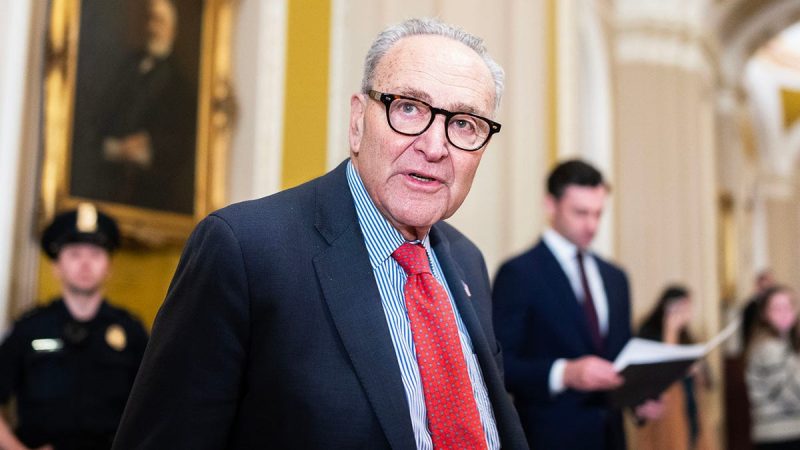
Senate Minority Leader Chuck Schumer, D-N.Y., told reporters before leaving the Capitol that Democrats’ goal was to have the remaining slate of appropriations bills completed by the Jan. 30 deadline. It takes 12 spending bills to fund the government, and so far, neither chamber has come close to hitting that mark.
‘We want to get through the process and get the appropriations bills done,’ Schumer said.
It’s a stark departure from his and Democrats’ earlier position, given that they shut the government down for a record 43 days in a bid to bring expiring Obamacare subsidies to the forefront of discussions.
Congressional Democrats also have been leery of working with their Republican counterparts after President Donald Trump’s roughly $9 billion clawback package, which cut funding to already agreed-to programs and priorities, passed on a partisan vote over the summer.
A similar issue played out just as the Senate was on the cusp of advancing a five-bill spending package before skipping town.
Sens. Michael Bennet, D-Colo., and John Hickenlooper, D-Colo., held up the process over the Trump administration’s plan to dismantle the National Center for Atmospheric Research (NCAR) in Boulder, Colorado.
Office of Management and Budget Director Russ Vought had just announced that same day that the facility would be put under a microscope, and charged that the NCAR was ‘one of the largest sources of climate alarmism in the country.’
For now, the duo appear entrenched in their position.
‘This holiday season, hundreds of NCAR employees face uncertainty about their jobs and communities across the state are worried they won’t get the support they need to rebuild their lives after historic flooding and wildfires,’ Bennett said in a statement. ‘Colorado deserves better, and I am doing everything in my power to fight back and protect our state from the President’s vindictive chaos.’
There’s also the issue of dealing with the Obamacare subsidies, which will have expired by the time lawmakers return to Washington, D.C. A group of bipartisan senators are working on a possible solution, and there are plans in the House — one from the GOP that already passed and another bipartisan effort that is expected to get a vote early January — that could make their way onto the Senate floor.
And Congressional Democrats are likely to use the healthcare issue as leverage during the impending spending fight.
Exactly how lawmakers avoid another shutdown is still in the air. The Senate is determined to advance its five bill package, which includes legislation to fund the departments of Defense, Labor, Health and Human Services, Education, Commerce, Justice, Interior, Transportation, and Housing and Urban Development.
But in order for those bills to make it to Trump’s desk, the House has to agree. So far, the lower chamber has only passed a handful of spending bills, and has not brought any appropriations bills to the floor for months.
Senate Majority Leader John Thune, R-S.D., already is gaming out a ‘a contingency plan.’
‘We got to fund the government by the end of the month,’ Thune said. ‘And so we’re looking at, you know, determining what that looks like, obviously, if we can pass the five bill package, and if we can’t, then what that looks like.’
‘So there’s a lot of thought being given and just to make sure that we don’t end up in a, you know, posture at the end of the month where we’re looking at, staring at a shutdown again,’ he continued.